The word brainstorm brings to mind a room full of enthusiastic people shouting ideas at a whiteboard. In reality, many brainstorming sessions are dominated by a few voices, and the best ideas of the quieter members never surface. With a clear structure and some thoughtful facilitation, you can run sessions where everyone contributes and the output is genuinely useful.
Define the challenge clearly
A good brainstorm starts with a good question. Frame the challenge as an open question, such as, “How might we make our onboarding feel more welcoming?” Share it in advance so people can think before they arrive. Vague topics produce vague ideas.
Start alone, then share
A powerful technique is to begin with a few minutes of silent writing. Each person jots down ideas on sticky notes or in a shared document before any discussion. This prevents early ideas from anchoring the group and gives quieter people an equal voice.
Separate generating from judging
Ask people to hold back criticism while ideas are being created. Evaluating too early stops people from sharing the slightly unusual ideas that sometimes lead to the best solutions. Set aside a distinct phase for evaluating once the ideas are out.
A simple structure
- Introduce (5 minutes): restate the challenge and the ground rules.
- Write silently (5 minutes): everyone captures their own ideas.
- Share and group (15 minutes): read out ideas and cluster similar ones.
- Vote or discuss (10 minutes): use dots or a quick rating to choose favourites.
- Decide next steps (5 minutes): who will develop which ideas.
Make it visual
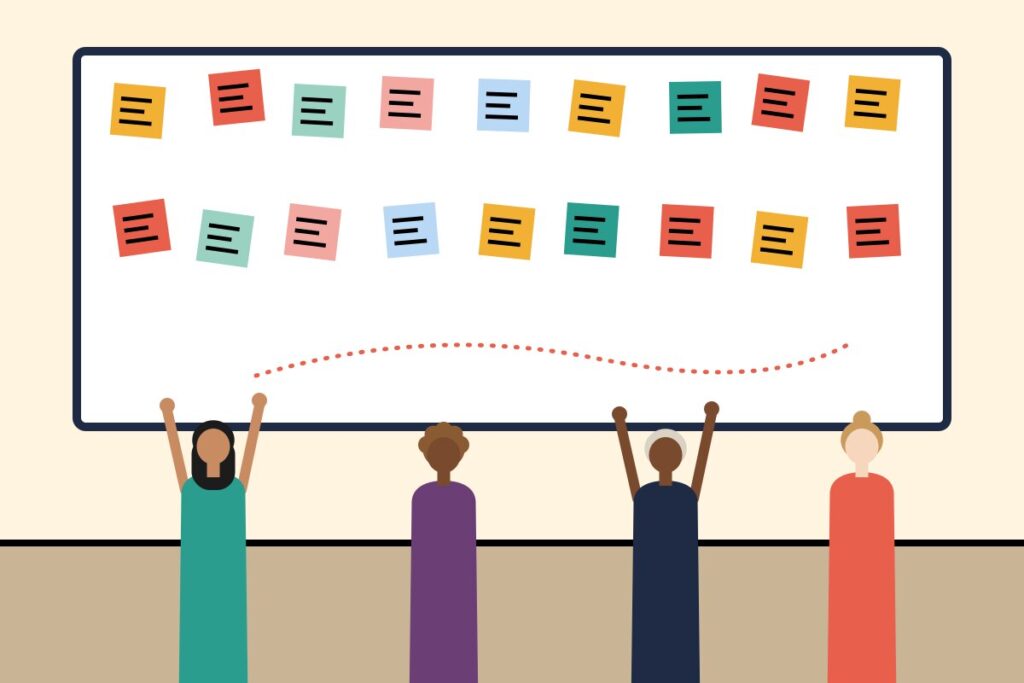
A whiteboard, wall, or digital canvas helps everyone see the ideas and make connections. Use colour to distinguish themes, and take a photograph or export the board before you leave.
Keep energy up
Short sessions often work better than long ones. If energy drops, change the activity, take a short break, or invite people to build on one another’s ideas with “yes, and” thinking.
Follow up on the ideas
A brainstorm only creates value if ideas are carried forward. Assign owners for the top ideas, set a date to revisit them, and share the full list with participants.
With a little structure, a brainstorm can unlock the creativity of the whole team. Try the silent-writing start next time and notice how many more voices you hear.