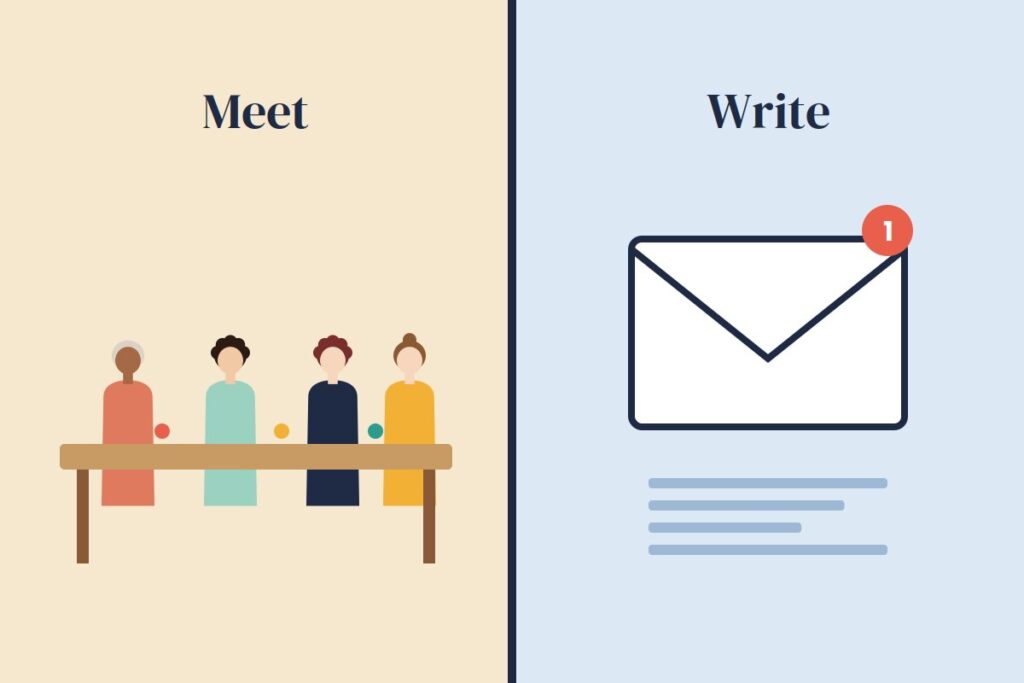
Few workplace habits are as automatic as scheduling a meeting. Someone has a question, a topic feels complicated, and a calendar invitation goes out. But many issues can be solved in a clear message, and some conversations are far too nuanced for one. Choosing well between the two saves time and avoids misunderstandings.
Choose a meeting when…
- The topic is complex, sensitive, or emotional.
- You need a decision that involves trade-offs and several perspectives.
- People need to brainstorm and build on one another’s ideas.
- There is likely to be confusion or disagreement that a message could make worse.
- You are building trust, welcoming a new colleague, or celebrating something.
Choose a message when…
- You are sharing information or an update that needs no discussion.
- You need answers to a few simple questions.
- People work in different time zones or have different schedules.
- You want to give people time to think before responding.
- You need a written record of what was decided.
A quick test
Ask yourself three questions before sending an invitation. First, does this need real-time discussion? Second, will the outcome be better with people in the same conversation? Third, could I explain this clearly in a short written message? If the answer to the third is yes, and the first two are no, send the message.
The middle options
There are more tools than just these two. A short recorded video can explain a process or share an update with the nuance of tone. A shared document with comments lets people react at their own pace. A five-minute phone call can resolve a question faster than a long thread. Treat the choice as a spectrum, not an either-or.
Write messages that work
If you choose written communication, make it easy to act on. Put the request and deadline in the first sentence. Use short paragraphs or bullet points. Say who needs to do what. A clear message prevents the follow-up meeting you were trying to avoid.
Be willing to change your mind
If a thread has gone back and forth more than three or four times without progress, it is time to talk. Equally, if a meeting ends with only one person speaking, it probably should have been an email.
The best teams develop a shared sense of when to meet and when to write. Talk about it with yours, and agree a few simple guidelines.